2.2
Important personalities and discoveries in pharmacology
There were many significant personalities in the field of pharmacology. The first one was probably Hippocrates (460B.C. - 377B.C.) called the Father of Medicine. He was the first to attempt to separate the practice of medicine from religion and superstition. Hippocrates was the one who developed his pledge of proper conduct for doctors known as Hippocratic Oath.
Interesting
“…I will use treatment to help the sick according to my best ability and judgment, but never with the view to injury and wrong doing…Into whatsoever houses I enter, I will enter to help the sick.”
+
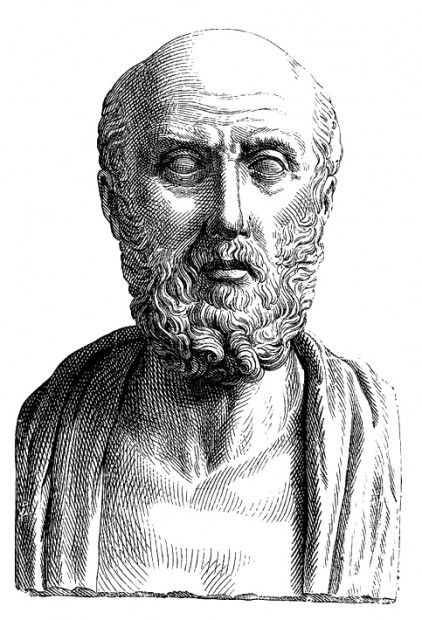
Source: Hippocrates, license Public domain.
Fig. 1. Hippocrates of Kos
Pharmacology existed in the ancient civilizations as well. The Ebbers papyrus describes more than 700 drugs in extensive pharmacopeia of that civilization. It includes for example beer, turpentine, berries, poppy, lead, salt and crushed precious stones. They were so called Egyptian remedies.
Dhanvantari was an early Indian medical practitioner and probably one of the world´s first surgeons, who is also regarded as the source of Ayurveda. He perfected many herbal-based cures and natural remedies and was credited with the discovery of the antiseptic properties of turmeric and the preservative properties of salt, which he incorporated in his cures.
+
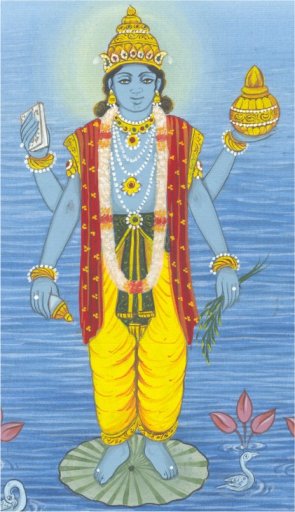
Source: Author F16, A detail from a miniature painting in the Rajastani style, made by the artist LaLa in Udipur, ordered pecially by en:user:F16. Painted in September 2004. shows the Hindu god Dhanvantari., license CC-BY-SA-3.0.
Fig. 2. Dhanvantari
Susruta is an ancient Hindu medical text describing about 760 herbs and their effects.
Paracelsus (1493 – 1541) pioneered the use of chemicals and minerals such as zinc in medicine. He strongly opposed to polypharmacy – the prescription of multiple substances.
+
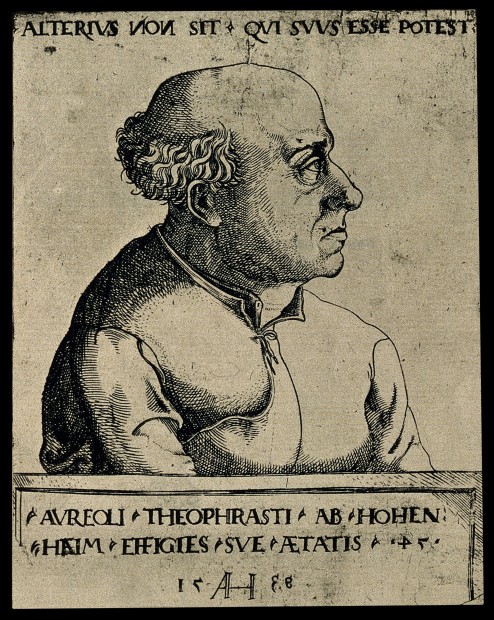
Source: Author Wellcome Collection, Aureolus Theophrastus Bombastus von Hohenheim (Paracelsus)., license Creative Commons BY 4.0.
Fig. 3. Paracelsus
Claude Bernard (1813 – 1878) was a French physiologist who contributed to pharmacology in several ways. He discovered the role of the pancreatic secretion in the fat digestion. Furthermore, he found out that curare (the arrow poison) specifically blocks motor nerve endings – interrupts the stimulation of muscle. Moreover, he also observed vasodilation and vasoconstriction.
+
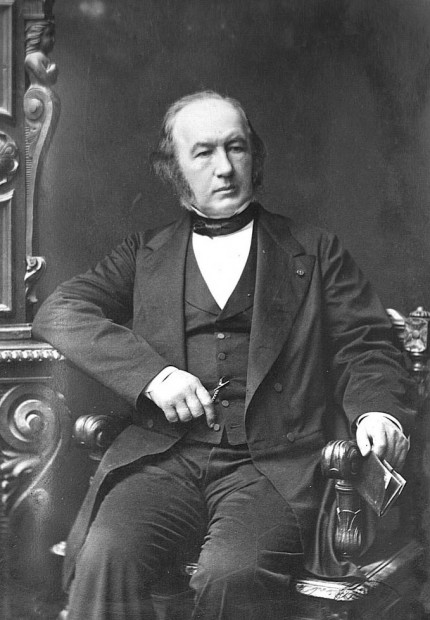
Source: Author Unknown author, Claude Bernard., license Public domain.
Fig. 4. Claude Bernard
Oswald Schmiedeberg (1838 – 1921), a German doctor and pharmacologist, is generally recognized as the founder of modern pharmacology. In 1878 he published Outline of Pharmacology.
John Jacob Abel (1857 – 1938) was an American pharmacologist who trained under Schmiedeberg. He gave pharmacology its name as a subject. What´s more, he also isolated epinephrine from adrenal gland extracts, amino acids from the blood and histamine from pituitary extract. In 1926 he succeeded in preparation of pure crystalline insulin.
+
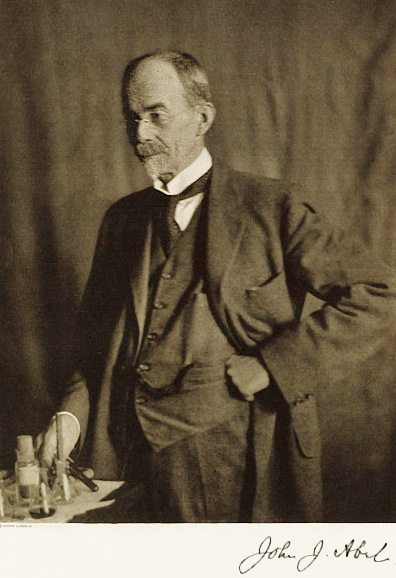
Source: Author Doris Ulmann (1882-1934), John Jacob Abel (19 May 1857 – 26 May 1938), license Public domain.
Fig. 5. John Jacob Abel
Alexander Fleming (1881 – 1955) is one of the best known personalities in pharmacology. This Scottish biologist and pharmacologist discovered enzyme lysosome in 1923, but his greatest discovery was antibiotic Penicillin from the mould Penicillium notatum in 1928. It is said that he discovered penicillin by chance after returning to his lab after holidays. Before leaving, he had left all his Petri dishes with staphylococci on a bench in his lab. After returning he noticed that one culture was contaminated with a fungus and that the colonies that had surrounded it had been destroyed. He won the Nobel Prize in Physiology and Medicine in 1945 and shared it with Howard Florey and Ernst Chain who purified penicillin and are credited for its industrial production.
+
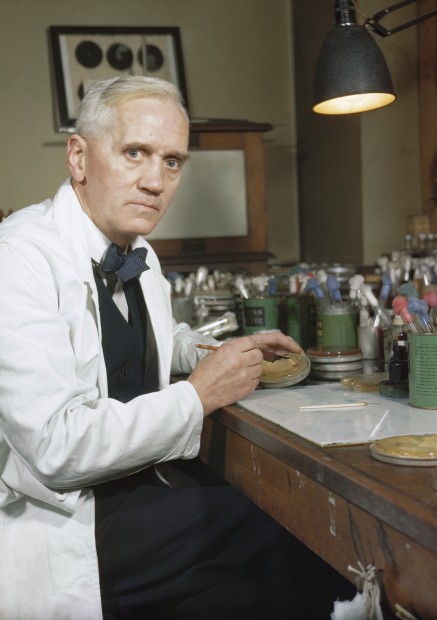
Source: Author Official photographer, Synthetic Production of Penicillin Professor Alexander Fleming, holder of the Chair of Bacteriology at London University, who first discovered the mould Penicillin Notatum. Here in his laboratory at St Mary's, Paddington, London (1943)., license Public domain.
Fig. 6. Alexander Fleming
Sir Frederic Grant Banting (1891 – 1941), a Canadian doctor and scientist, and Charles Best (1899 – 1978), his assistant, are known for the discovery of insulin – one of the most significant advances in medicine, enabling an effective treatment of diabetes. In 1923 Banting won the Nobel Prize and shared his award money with Best.
+
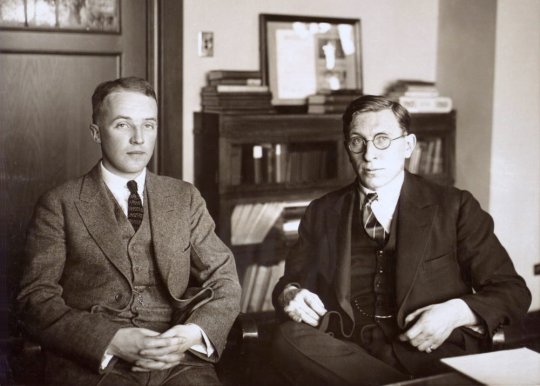
Source: Author University of Toronto Library, Charles H. Best and Banting, c. 1924., license Public domain.
Fig. 7. Banting and Best
Louis Lasagna (1923 – 2003) was a famous American clinical pharmacologist known for revising the Hippocratic Oath in 1964 but mostly for conceptualizing controlled clinical trials and the placebo effect. His work led to the improvement of clinical trials and what´s more, it improved the regulation of drugs in connection with safety.
+
Fig. 8. Louis Lasagna
The history of acetylsalicylic acid

Video 2. The history of aspirin
Note
Some historical landmarks in pharmacology
- Morphine – Serturner (1805)
- Histamine – Vogt (1907)
- Oxytocin – Abel (1919)
- Insulin – Banting and Best (1922)
- Penicillin – Fleming (1928)
- Sulfonamides – Domagk (1932)
- Streptomycin – Waksman (1944)
- Lithium – Cade (1950)