7.2
The Use of Articles
The use of articles is very often the main objective of proofreading a paper or a thesis.
Definition
There are indefinite (a/an) or definite (the) articles in English. There is a huge number of rules that could help systematise the problem of articles. The main rule is that you are supposed to use an indefinite article when you are speaking in general (it can be referred to any object of that kind). When you mean a specific, known object or a value, it is recommended to use a definite article.
The way you use articles depends on whether a given noun is countable or uncountable.
+
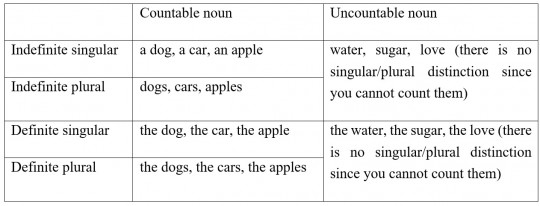
Fig. 22. The use of articles with countable / uncountable and singular / plural nouns.
Disadvantage
Please, note that you should use articles with indefinite singular countable nouns, but you should not use articles with indefinite plural or uncountable nouns.
Advantage
In case the noun is something definite, you don’t have to think, whether it is countable or not – the article is “the.” The use of definite articles seems a bit simpler.
Note
Pronunciation of “the” can differ based on the following word. If it is followed by a consonant, the pronunciation is more like “thə”. If it is followed by a vowel (or a silent consonant), the pronunciation is more like “thē”.
Example
Please, compare:
- The dog – thə (consonant)
- The house – thə (pronounceable h)
- The hour – thē (silent h)
- The apple – thē (vowel)
Video 2. Schwa (ə) sound.
The best way to master your skills is to practice (basic):
The best way to master your skills is to practice (medium):
Let’s have some more practice (advanced):
Read the text below (extracted from a thesis) and fill in the blank spaces A, AN, THE, or no article:
Example
_____ Compensation of _____ Chromatic Dispersion
_____ Chromatic dispersion must be compensated for in _____ long haul networks. In _____ basic network (10 Gbps, _____ NRZ on off modulation), _____ maximum reach for _____ G.652.D optical fibre without _____ compensation for _____ chromatic dispersion was found to be _____ 101 km [23]. At this distance _____ BER was 1.52×10⁻⁹ and _____ Q factor was 6.36. _____ total dispersion after 101 km was approximately _____ 1700 ps/nm, as seen in _____ Figure 14. _____ systems overall performance and _____ maximum reach could be improved by _____ compensating for _____ dispersion.
In order to extend _____ reach of _____ network, _____ optical fibre was replaced with _____ typical DSF. Using _____ G.653 DSF, _____ maximum reach without _____ amplification was ex-tended to 120 km [24]. At this distance, _____ BER (3.66×10⁻⁹) and _____ Q factor (5.78) indicated _____ system performance had not degraded. For this example, _____ dispersion was _____ 0 ps/nm since _____ operating wavelength corresponded to _____ zero dispersion of the fibre. Therefore, using _____ DSF allowed _____ reach to be extended by 18.8 %, but would not be useful in _____ more complicated WDM networks as _____ nonlinearities have _____ greater affect when there is no dispersion cite.
Another technique to compensate for _____ chromatic dispersion is to use _____ DCFs. _____ EWBDK fibre was chosen to represent _____ DCF as it has _____ typical values of -120 ps/(nm·km) at _____ 1550 nm [25]. _____ simple post-compensation scheme was simulated where _____ DCF was added after _____ 101 km G.652.D fibre (_____ maximum reach). After comparing simulations where both _____ SMF and _____ DCF lengths were varied, _____ best results were found when _____ SMF was 108 km and _____ DCF was 5 km. _____ BER and _____ Q factor were 7.25×10⁻⁹ and 5.69, respectively. _____ network’s total distance was 113 km and therefore _____ DCF allowed for _____ network reach to be extended by _____ 11.9 %.
_____ BER of the system greatly depended on _____ length of the DCF. _____ relationship between _____ BER and _____ DCF length may be seen in _____ Figure 15 A. Because of their negative dispersion, DCFs up to approximately 7 km improved _____ overall system performance. We can see from _____ Figure 15 A that _____ DCFs longer than 7 km are more detrimental to _____ system than helpful. This is because they have _____ higher loss, 0.5 dB/km, which reduces _____ power of _____ received signal and decreases _____ BER.
Key:
Show the solution
Hide solution
Solution
Compensation of Chromatic Dispersion
Chromatic dispersion must be compensated for in long haul networks. In a basic network (10 Gbps, NRZ on off modulation), the maximum reach for a G.652.D optical fibre without compensation for chromatic dispersion was found to be 101 km [23]. At this distance the BER was 1.52×10⁻⁹ and the Q factor was 6.36. The total dispersion after 101 km was approximately 1700 ps/nm, as seen in Figure 14. The systems overall performance and maximum reach could be improved by compensating for the dispersion.
In order to extend the reach of the network, the optical fibre was replaced with a typical DSF. Using a G.653 DSF, the maximum reach without amplification was ex-tended to 120 km [24]. At this distance, the BER (3.66×10⁻⁹) and Q factor (5.78) indicated the system performance had not degraded. For this example, the dispersion was 0 ps/nm since the operating wavelength corresponded to the zero dispersion of the fibre. Therefore, using a DSF allowed the reach to be extended by 18.8%, but would not be useful in more complicated WDM networks as nonlinearities have a greater affect when there is no dispersion cite.
Another technique to compensate for chromatic dispersion is to use DCFs. An EWBDK fibre was chosen to represent the DCF as it has typical values of -120 ps/(nm·km) at 1550 nm [25]. A simple post-compensation scheme was simulated where the DCF was added after a 101 km G.652.D fibre (maximum reach). After comparing simulations where both the SMF and DCF lengths were varied, the best results were found when the SMF was 108 km and the DCF was 5 km. The BER and Q factor were 7.25×10⁻⁹ and 5.69, respectively. The network’s total distance was 113 km and therefore the DCF allowed for the network reach to be extended by 11.9 %.
The BER of the system greatly depended on the length of the DCF. The relationship between the BER and DCF length may be seen in Figure 15 A. Because of their negative dispersion, DCFs up to approximately 7 km improved the overall system performance. We can see from Figure 15 A that DCFs longer than 7 km are more detrimental to the system than helpful. This is because they have a higher loss, 0.5 dB/km, which reduces the power of the received signal and decreases the BER [4].
Interesting
Note that in English a dot (.) is used to express decimal notation instead of a comma (,) that is used in Czech for that purpose.
Example:
- 0.5 dB/km
- 11.9 %
- 3.66×10⁻⁹