1.7
Radio spectrum
The previous chapter dealt with the issue of radio communication towards providing two-way communication for telemetry, tracking, and commands (TT&C) in both the ground and space segments. A fundamental prerequisite for radio communication are frequencies suitable for communication in terms of propagation conditions and their protection against unwanted interference. These interferences may be caused by near-range radio and space-based radio systems or by electromagnetic interference caused by other on-board small satellite systems or other objects.
An overview of the potential for unwanted radio interferences is shown in Figure 32.
+
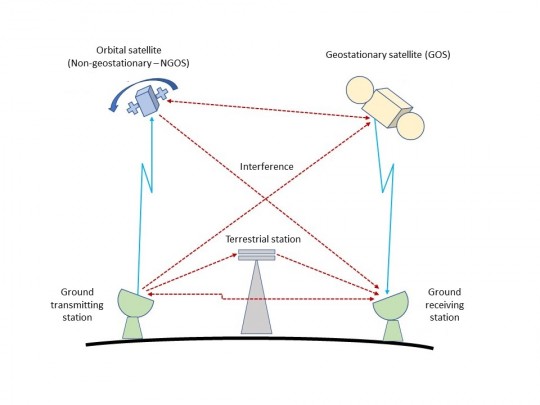
Fig. 32. Possibility of radio interferences between space and terrestrial services
It is, therefore, necessary to take technical-administrative measures of a global nature towards the management of radio spectrum for satellite services (fixed, mobile, navigation, radio, and television broadcasting, etc.). These issues are dealt by the International Telecommunication Union (ITU) and its Radio Regulations (RR). This is free to download at: https://www.itu.int/en/history/Pages/RadioRegulationsA.aspx?reg=1.41.
The Radio Regulations are subject to regular three to four-year updates. It is the agenda of the World Radiocommunication Conference (WRC) organized by the ITU-R radiocommunication sector. Administrative matters (regulation) will be discussed in more detail in the following chapter 1.8.
Radio Regulation in four volumes defined frequency bands from the range of spectrum from 9 kHz to 3000 GHz, which individual radiocommunication services use along with other technical and regulatory measures (coordination of the allocation of frequencies and orbits, recommendations, resolutions and technical reports on radiocommunication services).
In the Czech Republic, frequency allocations and the relevant provisions of the Radio Regulations are contained in the Decree No. 105/2010 Coll., on the plan for the allocation of frequency bands (national frequency table) to the Act No. 127/2005 Coll., for electronic communications.
For radio spectrum management purposes based on the Radio Regulations, the world is divided into three regions, as shown in Figure 33.
©
For licensing reasons, this image cannot be directly incorporated into the material. Click HERE to see the image.
Fig. 33. Definition of three regions in the ITU-R Radio Regulations for the Radio Spectrum Management
The allocation of radio spectrum bands to individual services distinguishes three categories - primary, secondary, and group allocation. The priority service has the right to protection against interference from other services. The secondary service must not interfere with the primary services and does not have the right to own protection. The group frequency allocation is subject to further division in geographical parts of the world.
Examples of group allocation of frequency bands for amateur radio service is managed and coordinated by the International Amateur Radio Union (IARU - International Amateur Radio Union, http://www.iaru.org/).
Exceptions to the frequency allocations are stated in the Radio Regulations footnotes (referred to as No. 5. xxx).
The Radio Regulations (Vol 1, Chapter II, Article 5) after WRC 15 allow the use of the following frequency bands for small satellites.:
Table 1. Frequency bands allocated to amateur service. These bands are coordinated by IARU according to the table.
Frequency band [MHz] | Utilization | |
10 m | 28.0–29.7 (primary) | Used together with 144 MHz band for uplink and downlink. |
2 m | 145.974–143.000 (primary, No. 5.282) | These bands are used in both directions not only by small amateur radio satellites, but also by various small projects in constellations with one or a small number of small satellites. |
70 cm | 435.000–438.000 (secondary) | |
23 cm | 1 260.0–1 270.0 (secondary, No. 5.282) | Only for uplink (Earth - Cosmos) in the 23 cm band. These bands are used as an alternative to the 2 m and 70 cm wavelengths due to their high occupancy and interference problems. |
2 400.0–2 450.0 (secondary, No 5.282) | ||
9 cm | 3 400.0–3 410.0 (secondary, only in Region 2 and 3), No. 5.282) | |
| 5 cm | 5 650.0–5 670.0 (secondary, No. 5.282) | Only for uplink for experimental amateur radio satellites. |
5 830.0–5 850.0 (secondary) | Only for uplink for experimental amateur radio satellites. | |
3 cm | 10 450.0–10 500.0 (secondary) | For amateur radio communication (voice, digital and morse operation). |
1,2 cm | 24 000.0–24 050.0 (primary) | |
6 mm | 47.0–47. 2 (primary) | For experimental amateur radio satellites. |
4 mm | 76.0–77.5 (secondary) 77.5–78.0 (primary) 78.0–81.0 (secondary) | |
2 mm | 134.0–136.0 (primary) 136.0–141.0 (seconadry) | |
1 mm | 241.0–248.0 (secondary) 248.0–250.0 (primary) |
No. 5.282 In the bands 435-438 MHz, 1 260-1 270 MHz, 2 400-2 450 MHz, 3 400-3 410 MHz (in Regions 2 and 3only) and 5 650-5 670 MHz, the amateur-satellite service may operate subjects to not cause harmful interference to other services operating in accordance with the Table (see No. 5.43). Administrations authorizing such use shall ensure that any harmful interference caused by emissions from a station in the amateur-satellite service is immediately eliminated in accordance with the provisions of No. 25.11. The use of the bands 1 260-1 270 MHz and 5 650-5 670 MHz by the amateur-satellite service is limited to the Earth-to-space direction.
The 2 m and 70 cm bands are used in several of small satellite missions that do not have the character of amateur radio service. These include a variety of school and university projects using small satellites CubeSat category. This is largely due to the fact that these projects did not historically need to be coordinated in ITU-R, and there is no charge for the use of these frequencies.
However, the amateur radio license (test, call sign, and individual of the right to use reserved radio frequencies) from a national regulatory authority is required for the use of amateur radio stations. In the Czech Republic, the national regulatory authority is the Czech Telecommunications Office (www.ctu.cz).
The second reason for the use of amateur radio bands is the availability of cheap radios with power up to 100 W; these radios are sufficient to communicate with small satellites in LEO orbits. Furthermore, a wide range of electronic components (e.g. SDR chipsets, cheap amateur-made YAGI antennas) for the on-board radio system construction of a small satellite and the building of a ground station are available, as described in the previous chapter 1.6.
This situation largely remains and has a negative reflection on congestion zones initially intended for the amateur service. As a result, there is an increased risk that unreliable radio communications with a small satellite can cause an early mission or in orbit incident. This can have an impact on the financial losses of such a project, possibly even compensating for damage caused by a small satellite.
2. Frequency bands allocated to fixed and mobile services located on orbiting satellites (NGSOs) and other space services requiring coordination under the Radio Regulations.
The use of these bands requires ITU-R to request coordination and notification of frequency allocation and orbit position under the provisions of the Radio Regulations (Section II, RR Article 9). This is a very lengthy process that can take several years. The validity of subsequent notification is limited to three years. It is burdened with extra charges; the ITU must pay for the use of the frequencies. This is a very limiting factor for most small satellite missions, especially for school and university projects. Besides, with the development, use, and simultaneous launch of more small satellites as part of constellations of different networks with a life span of less than three years, it needs to find other suitable frequencies and regulatory mechanisms for their use.
Therefore, WRC 15 adopted Resolution No. 659.
It required the study of radio spectrum requirements for telemetry, tracking and commands (TT&C) in the space service for non-geostationary satellites (NGSOs) with short mission duration. This will determine if existing allocations are suitable for the space operation service,
and assess new allocations for nanosatellites and picosatellites. The results of the studies will be discussed at the upcoming WRC 19 on the AI 1.7 agenda. They show that the existing allocations in the space bands below 1 GHz, which require coordination and notification under RR 9.21, are not appropriate for nanosatellites and picosatellites. The allocation 150.05–174.0 MHz and 400.15–420.0 MHz frequency bands are proposed. Meanwhile, the band 406.0–406.1 MHz which is reserved for rescue radio buoys (air and maritime traffic EPIRB, personal PLC) cannot be used.
At the CPM 19 Preparatory Conference, the WRC 19 Report proposed the following solutions (methods) [https://www.itu.int/pub/R-ACT-CPM-2019]:
Method A: No change RR.
Method B1: Allocation of 1 MHz is not subject to coordination under Section II, Article 9 of RR (uplink) space operation service for short-duration nanosatellites and picosatellite systems (NGSO SD) in the band 403–404 MHz.
Method B2: Allocation of 1 MHz not subject to coordination under RR Section II of Article 9 for uplink in the 404-405 MHz band.
Method C: Use the existing allocation of space services in the band 137-138 MHz for the downlink and 148-149.9 MHz for the uplink and to develop appropriate regulatory provisions in the RR for TT & C links NGSO SD missions.
All methods include a proposal to suppress Resolution 659 (WRC-15).
At the WRC 19, it can be expected that any allocation of certain sections of mentioned bands will be accompanied by a number of other conditions and restrictions, especially on issues relating to the plans of large (mega) constellations concerning the compatibility of existing space services.
It is also clear that the radio spectrum has its limits. With the further increase of the large constellation of small satellites, it will be necessary to seek other ways of dealing with secure and reliable communications.
The use of optical links (the carrier medium is a laser beam) both for communication between a ground station and small satellites (a ground segment) and with each other in space (a space segment) is prospective and promising.
An example of testing options for the use of optical communications for small satellites could be promising experiments with small CubeSat satellites implemented as part of NASA's Small Spacecraft Technology (SST) (https://www.nasa.gov/directorates/spacetech/small_spacecraft/index.html). There are many other promissing experiments in which NASA is active[https://www.nasa.gov/directorates/spacetech/feature/cubesat_laser_communications_capability].
There is no doubt that optical communication will play an important role in developing the use of small satellites and mega constellations.