3.2
Czech sights listed on the UNESCO World Heritage List
The UNESCO (the United Nations Educational, Scientific and Cultural Organization) approved the Convention Concerning the Protection of the World´s Cultural and Natural Heritage in 1972. The idea behind the convention was to select cultural monuments and natural areas of world significance in order to preserve them for future generations. The former Czechoslovakia joined the convention in 1991 and the Czech Republic took all the responsibilities flowing from the convention in 1993.
Taking into consideration its small territory the Czech Republic has a high concentration of sights. In terms of the number of items and the country’s territory, it is among the top 25 countries. Czech monuments are listed alongside the pyramids of Giza and Acropolis in Athens, together with more than one thousand world items (in 2018 there were 845 cultural, 209 natural, and 38 mixed). There are 12 Czech sites inscribed in the World Heritage List, namely
- Historic centre of Telč (1992)
- Historic centre of Český Krumlov (1992)
- Historic centre of Prague (1992)
- Pilgrimage church of St John of Nepomuk at Zelená Hora (1994)
- Kutná Hora: Historical town centre with the Church of St Barbara and the Cathedral of Our Lady at Sedlec (1995)
- Lednice-Valtice cultural landscape (1996)
- Holašovice historic village (1998)
- Gardens and castle at Kroměříž (1998)
- Litomyšl castle (1999)
- Holy Trinity column in Olomouc (2000)
- Tugendhat villa in Brno (2002)
- Jewish quarter and St Procopius´ basilica in Třebíč (2003)
- Apart from the list above the UNESCO established in 2008 the UNESCO Intangible Cultural Heritage list to protect craftsman skills, rituals and ceremonies, dances, music and music instruments, food product and gastronomy specialties, fairs and festivals. From Bohemia traditions there are listed Ride of the Kings, verbuňk dancing, falconry, puppeteering tradition, Shrovetide door-to-door processions and masks.
Interesting
There is also the UNESCO Memory of the World Register which lists precious and most valuable documents. The Leoš Janáček archives and the Great Siege of Malta Map from the second half of 16th century, which was discovered at the Charles University map collection in Prague, together with six more items have been inscribed to the register.
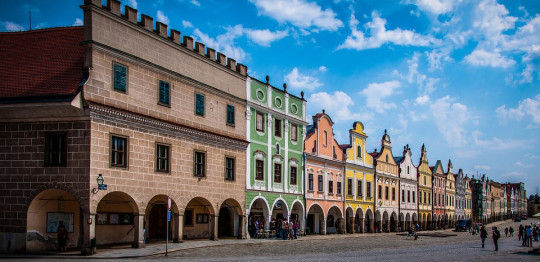
Telč is a perfectly preserved small medieval town. The square has some impressive townhouses dating from the Renaissance and Baroque periods. The historical interiors of its Renaissance castle (Blue and Gold Salons, the Knights Hall with its timber panel ceiling) are packed with priceless collections. Ecologically the region is one of the best preserved areas in the country and is often called the Green Heart of the Czech Republic. (www.telc.eu, www.telcsko.cz)
+
Source: Pixabay.com, license CC0
Fig. 16. Telč
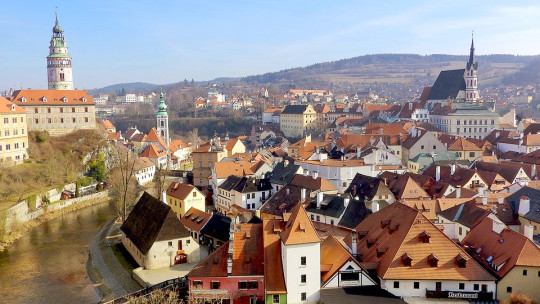
Český Krumlov has been known for its crooked lanes, medieval taverns, cozy pubs, and a unique complex of town houses below an impressive Renaissance castle. The town was ruled by the feudal Rožmberk family (1302– 1602) who made their family residence in a fairytale castle which includes the famous Masquerade Hall, the unique Baroque theatre, the chateau gardens with a Rococo fountains and the Bellarie Summer Palace with a revolving stage – a venue for summer theatre performances. The summer Five-Petal Rose Celebrations take place here. Another important cultural milestone was the foundation of the Egon Schiele Art Centre. (www.ckrumlov.cz)
+
Source: Pixabay.com, license CC0
Fig. 17. Český Krumlov
Prague was first described in the 10th century by the Arabian businessman Ibrahim Ibn Jakub as the city of stone and chalk. In 1348 the city became the royal residence. The Old Town continued to evolve, and in 1357 was linked to the lesser side on the left bank by the Charles Bridge. The four parts of the city (The Old Town, New Town, The Lesser Town and Prague Castle) were united in 1794 under Emperor Joseph II. The Prague Castle and St. Vitus Cathedral formed the intellectual and political centre.
All the historical milestones and architectural styles left their traces here. The Royal Road, the backbone of all the sights, starts with the Powder Tower, the monumental Gothic entrance to the Old Town. Next to the Tower, in the place of the former residence of Czech kings there is the Municipal House in the Art Nouveau style. On the way to the Old Town Square we pass the House at the Black Madonna, an excellent example of Czech cubism style from 1911-1912, designed by the architect Josef Gočár.
The Old Town Square is dominated by the Old Town Hall with the astronomical clock from 1410. The clock displays the parade of 12 apostles every hour being watched by the crowds from the square.
The upper part of the clock shows the course of the Sun and the Moon as well as the time of the day, while the lower part is a calendarium which shows the individual days and months of the year. The calendarium was decorated by Josef Mánes himself (1865).
The splendid Gothic Týn Church, where the Danish astronomer Tycho de Brahe was buried dominates the square. Next to it there is the Gothic House at the Stone Bell, presumed to be the seat of John of Luxembourg and his wife Eliška Přemyslide and later the Emperor Charles IV. In maybe the most beautiful Rococo building in Prague, the Goltz-Kinský Palace, Berta Suttnerová, the first female Nobel Prize winner, was born. Franz Kafka studied from 1893 to 1901 in the palace where his father had a shop.
The House At the Minute with its facade decorated with biblical and mythological scenes is said to be one of the most beautiful Renaissance buildings in Prague.

Video 1. Tips for sightseeing in Prague

Video 2. The Old Town Hall in Prague
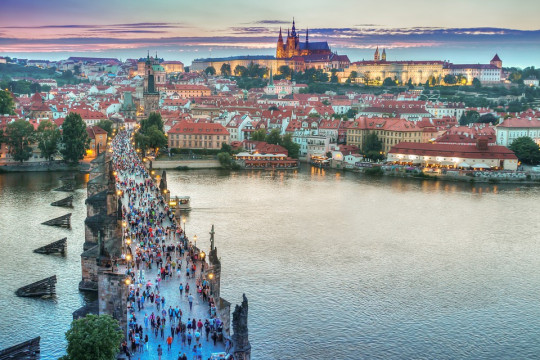
The Baroque statues on the Charles Bridge will lead us to the Lesser Town of Prague. It is the quarter of palaces and houses with special names: The House at the Painters, At the Tomcat, At the Three Fiddles, At the Two Suns (where the poet and writer Jan Neruda lived). One of the first cafés in Prague was opened in 1714 in the House At the Three Ostriches.
+
Source: Pixabay.com, license CC0
Fig. 18. Charles Bridge
From a nearby Church of Our Lady Victorious with the well-known statue of the Infant of Prague the tourist pour to the Prague Castle area dominated by St. Vitus Cathedral, Loretto, Golden Lane and other touristic highlights.
+
Source: Pixabay.com, license CC0
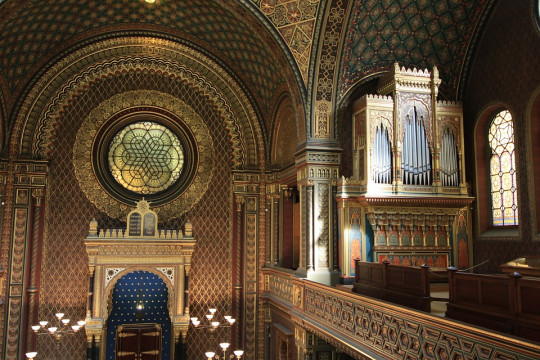
Fig. 19. Spanish synagogue
Though it is only the historical centre of Prague which is inscribed on the World Heritage List the Jewish Town with its precious synagogues (the Old-New Synagogue, the Maisel Synagogue, the Pinkas Synagogue, the Spanish Synagogue, the Klaus Synagogue) and the well preserved cemetery should be mentioned as well. (https://www.prague-guide.co.uk/prague-brief-history/)
The pilgrimage church of St John of Nepomuk at Zelená hora was built in the early 18th century in honour of the Czech martyr and saint, John of Nepomuk. The Prague architect, Jan Blažej Santini incorporated the 5-pointed star into the building as according to legend, a crown of five stars appeared over the body of the drowned martyr. The 5-pointed star appears throughout the Gothic Baroque building (the layout is star-shaped, the church has five exits, there are five stars on the altar and five angels). The dome is decorated with one of the symbols associated with St John of Nepomuk, a huge tongue to symbolize his loyalty to the Queen. (www.zdarns.cz)
+
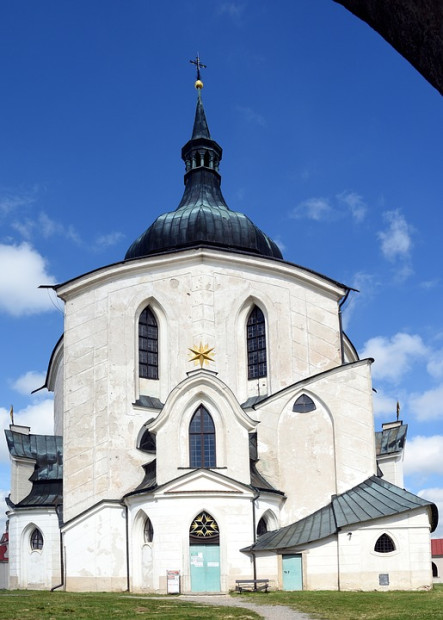
Source: Pixabay.com, license CC0
Fig. 20. St John of Nepomuk church
The history of medieval town of Kutná Hora is closely linked with local silver mines which became one of the main sources of silver in medieval Europe. At the end of the 13th century one third of all silver in Europe was mined in Kutná Hora. In the Italian Court, a complex of buildings from the 13th and 14th centuries and the economic heart of the Czech state, Prague groschen were minted. These were one of medieval Europe’s strongest currencies. Thanks to its wealth, Kutná Hora became the second most important town in the Czech kingdom.
+
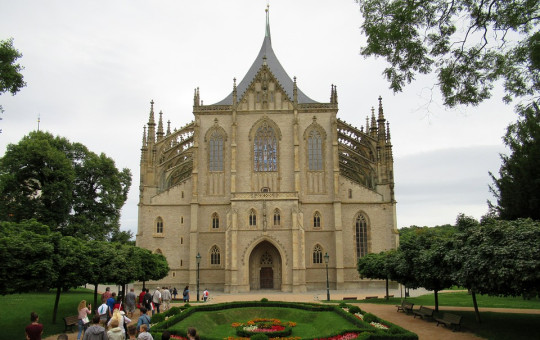
Source: Pixabay.com, license CC0
Fig. 21. St Barbara Kutná Hora
The Gothic Church of St James (1330) and the Cathedral of St Barbora (1388), the patron saint of miners, are the town’s most important sights. The Cathedral of St Barbora is one of the finest examples of high and late Gothic architecture in the Czech lands. It was founded in 1388 and a large part of it was funded by the miners. Kutná Hora always tried to compete with Prague, and architects and builders from Prague were brought in to work on the cathedral. The first architect was Jan Parléř, the son of Petr Parléř who began the Cathedral of St Vitus in Prague. The similarity between the two cathedrals is of no surprise. Due to the interruptions in stormy history it was completed only in 1905.
All Saints Chapel in nearby Sedlec houses the bizarre ossuary which interior is decorated with human bones. (www.kutnahora.cz http://www.guide.kh.cz/)
Lednice - Valtice area covers 200 km2, it is one of the largest manmade landscape projects in Europe. It was created from the 17th to the 20th century on an estate belonging to the Liechtenstein family. The Lednice Chateau is situated in extensive parkland on the banks of the Dyje river. There is a minaret in the pseudo-Moorish style and a glasshouse, artificial ruins of Janohrad, the Apollo’s Temple, and the neo-classical summer house Three Gracias. The Valtice Renaissance chateau was during the Thirty Years War badly damaged by the Swedish army. The destroyed building was later rebuilt into the Baroque residence. (http://en.czech-unesco.org/lednice-valtice-cultural-landscape/introduction/)
+
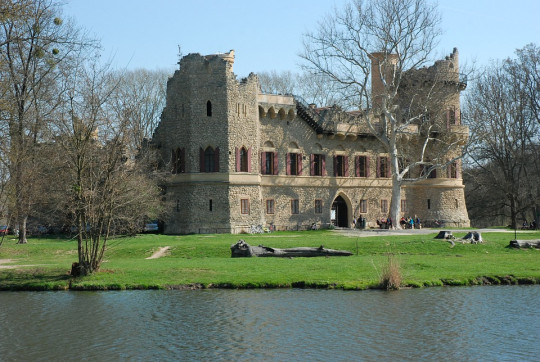
Source: Pixabay.com, license CC0
Fig. 22. Lednice Janohrad
+
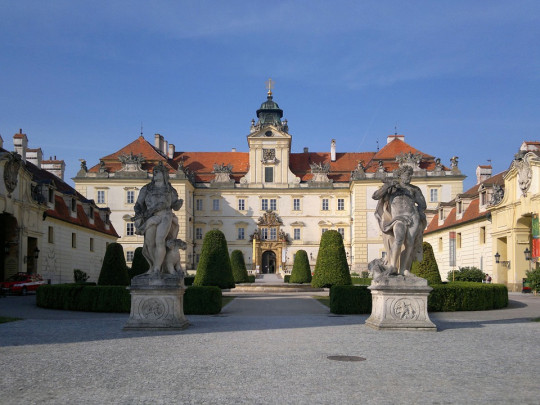
Source: Pixabay.com, license CC0
Fig. 23. Valtice Castle
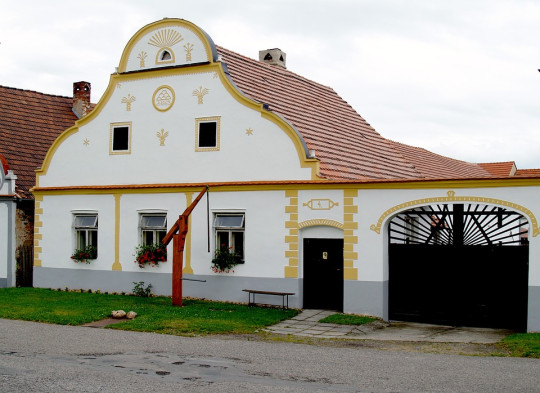
Holašovice is a traditional village in the so-called South Bohemian folk Baroque style. It has a well-preserved historical village green with several examples of brick-built rural farms from the 18th and 19th centuries. Some 20 buildings stand around a pond in the middle of the village green, many with decorated Baroque gables and concealing large gardens. Local markets present original folk arts and crafts. Visitors can see lace making, woven clothing, leather goods, wood carvers, knife makers, coin minters, blacksmiths, potters and many others. (www.holasovice.eu)
+
Source: Pixabay.com, license CC0
Fig. 24. Holašovice
The bishops and archbishops of Olomouc chose Kroměříž as their summer residence. The Palace halls are full of valuable furniture and works of art. The chateau library contains almost 100,000 manuscripts, early printed books, old works, drawings and graphic art. The Podzámecká (Under-castle) garden was transformed in the 19th century into an English style park with 3 lakes, colonnades, and the Chinese pavilion. The Květná (Flower) garden measures 16 hectares of shrub mazes and ornamented flowerbeds. It has a 244m long gallery of statues depicting Greek and Roman gods, and a central rotunda. (www.mesto-kromeriz.cz)
+
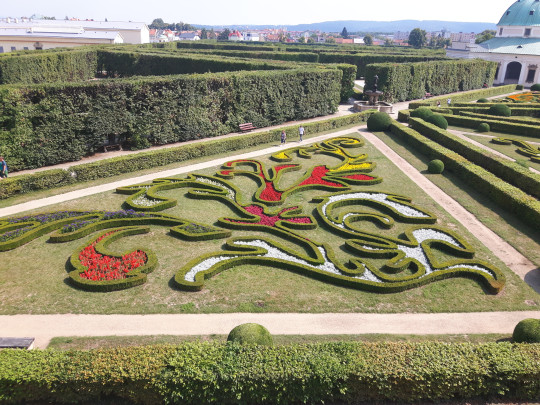
Fig. 25. Flower Garden Kroměříž
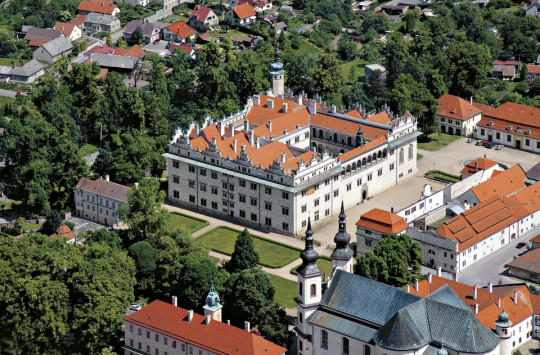
The Pernštejn family seated in Litomyšl had the original medieval castle rebuilt in the mid-16th century into a chateau which is a superb example of Renaissance architecture inspired by Italian style. Despite numerable alterations the chateau has kept its original Renaissance appearance almost intact including its unique sgraffito-decorated facades. A number of outbuildings and gardens have also survived. The castle area includes a 200-year-old Baroque theatre with some original pieces of stage scenery.
+
Source: Pixabay.com, license CC0
Fig. 26. Litomyšl Castle
The long, thin square is dominated with a Gothic town hall and lined with arcading and numerous Renaissance and Baroque townhouses. Among the finest of these is the Renaissance Knights’ House dating from the 16th century, now home to an art gallery.
Another interesting place is the Portmoneum, a unique museum with walls covered in murals and carved furniture, all the work of a renowned Czech artist, Josef Váchal.
Litomyšl is also the birthplace of the great Czech composer, Bedřich Smetana, in whose honour the Smetana’s Litomyšl opera festival is named. (www.litomysl.cz )
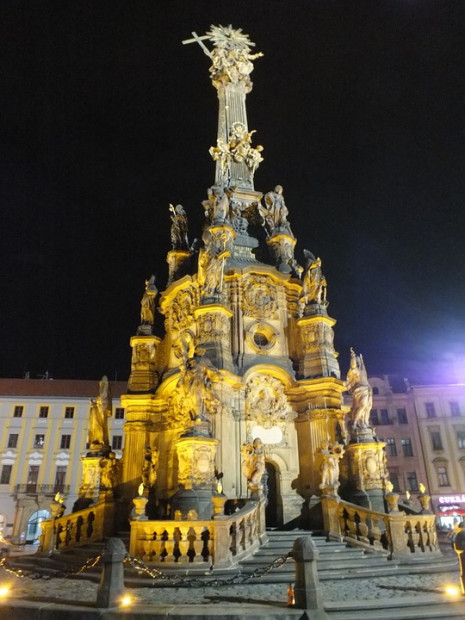
In the heart of Olomouc there is the second largest protected urban reservation in the country with many historically and architecturally important buildings. The Baroque Trinity Column which at 35m high is one of the tallest in the Czech lands, was erected in 1716–1754 and represents the largest in central Europe collection of Baroque statues in one piece of sculpture including the inner chapel. Its monumental appearance is a blend of architectural styles, which have special artistic value. (www.olomouc-tourism.cz)
+
Source: Pixabay.com, license CC0
Fig. 27. Olomouc Trinity Column
Villa Tugendhat in Brno, a unique piece of modern architecture, was built in 1929 for Greta and Fritz Tugendhat by Ludwig Mies van der Rohe. It now belongs to the City of Brno and is opened to the public. Two large windows reaching from the ceiling to the floor could be opened electronically giving access to the garden. The house was equipped with photocells and air conditioning. Furniture was made from exotic woods such as palisander and ebony. Travertine is used on the floors and the onyx wall comes from the Atlas Mountains in Morocco. (www.tugendhat-Villa.cz)

Video 3. Vila Tugendhat Brno
The most famous in Třebíč is the Romano-Gothic Basilica of St Procopius dating from the mid-13th century which has survived in its original shape and architectural style. The Jewish quarter survived in a surprisingly well shape, namely two synagogues and some 123 other buildings including a town hall, a rabbinate, a Jewish school, a workhouse, a hospital, a ritual slaughterhouse, a tannery and the cemetery with its ceremonial hall. The local Jewish cemetery is the biggest Jewish cemetery in the Czech Republic with 3,000 tombstones and 11,000 graves. (www.trebic.cz)
+
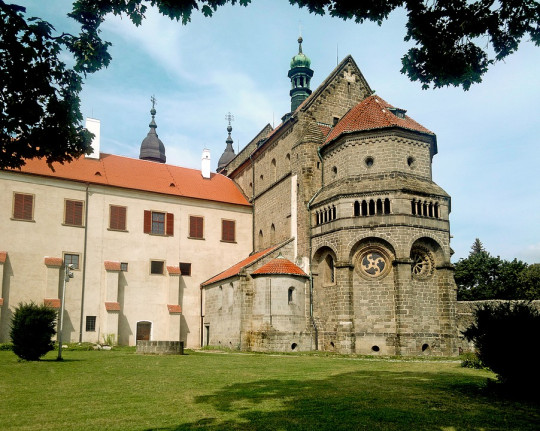
Source: Pixabay.com, license CC0
Fig. 28. Třebíč St Procopius church